NeurIPS 2026 · Spotlight

Natural JammersWhen Non-Robust Features Become Antagonistic

Jiaming Zhang1 Fuyao Zhang1 Pengjun Xie2 Wei Yang Bryan Lim1
1Nanyang Technological University 2Alibaba Group
Paper coming soon Code Weights BibTeX

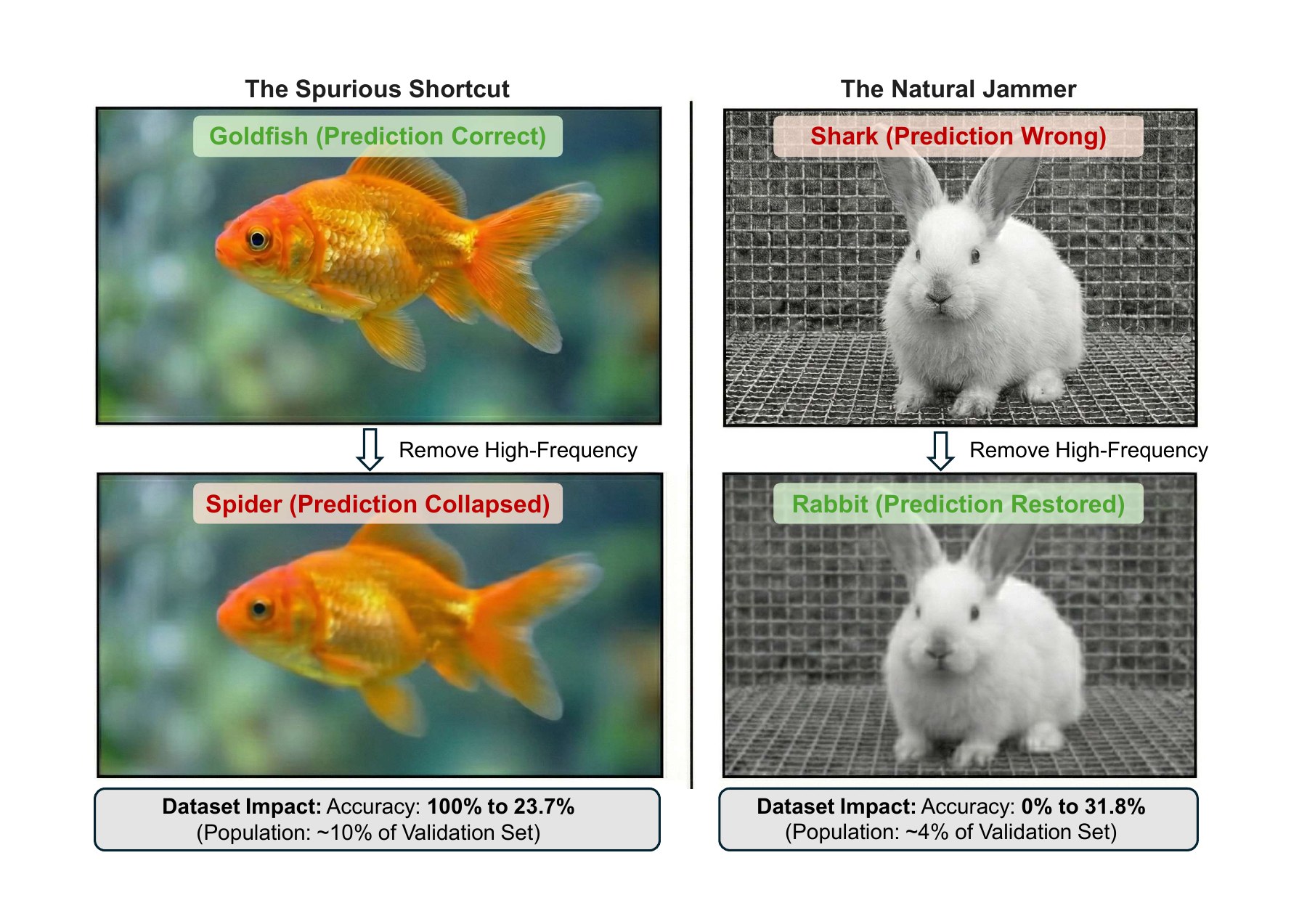
Standard classifiers are expected to beat adversarially robust ones on clean images. We find clean ImageNet images where the opposite holds: the standard model is wrong and the robust model is right. On these natural jammers, high-frequency patterns tied to the image’s layout mislead the standard model. Removing them, or shifting the image slightly, brings the right answer back, yet the share of jammed images stays the same.

4.28%of clean ImageNet validation images are jammed for a standard vs. robust ResNet-50
17 of 17robust models find jammed images, 3.1%–5.3% of the data
0 → 31.8%accuracy on jammed images after a low-pass filter
0.17%of other images inherit the wrong label when a jammer’s high frequencies are moved onto them
Two examples. Left, a goldfish is classified correctly, and the prediction collapses to spider when high frequencies are removed. Right, a rabbit is misclassified as shark, and removing high frequencies restores the correct label.
Removing high frequencies has opposite effects. A spurious shortcut (left) loses its correct prediction; a natural jammer (right) gets its correct prediction back.

What is a natural jammer?

We run a standard ResNet-50 and an adversarially trained ResNet-50 on every ImageNet validation image and sort the images by which model is right.

Robust model rightRobust model wrong
Standard model rightCommon33,071 (66.1%)Spurious5,002 (10.0%)
Standard model wrongJammed2,140 (4.28%)Uninformative9,787 (19.6%)

Every robust model we tried finds jammed images, but each finds different ones. Across 17 robust models (ResNets, WideResNets and ViTs), the Jammed Set covers 3.1%–5.3% of the data. Between architectures, the jammed images overlap little (IoU typically below 0.15): which images are jammed depends on the model.

Spectral–spatial locking

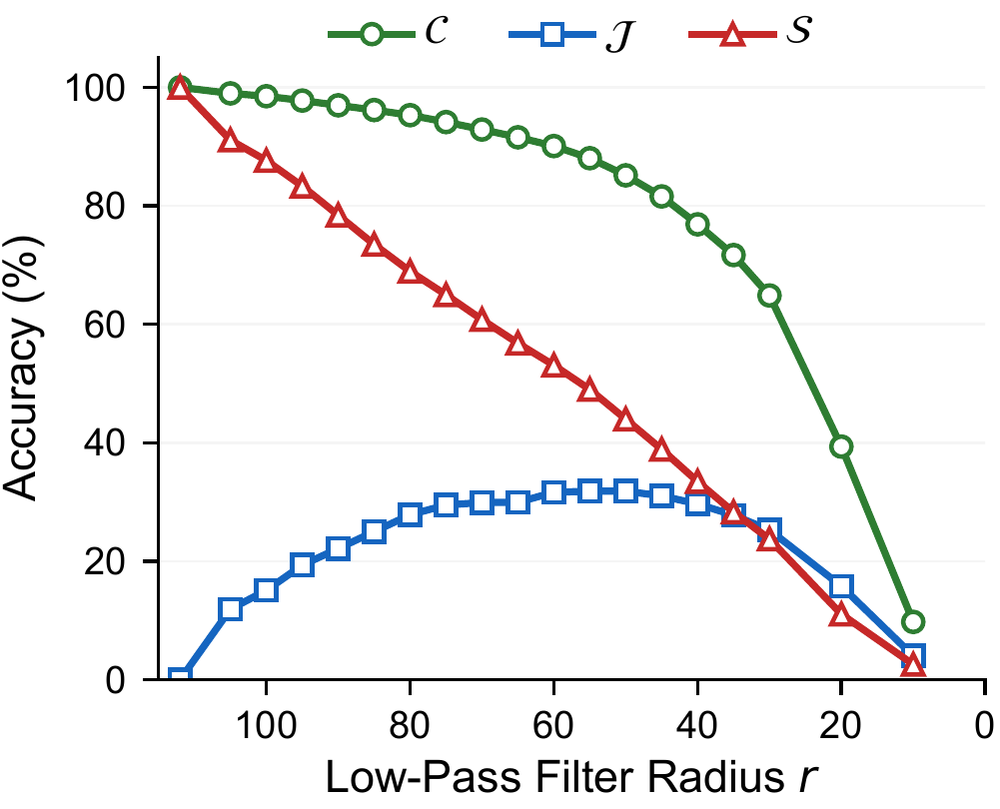
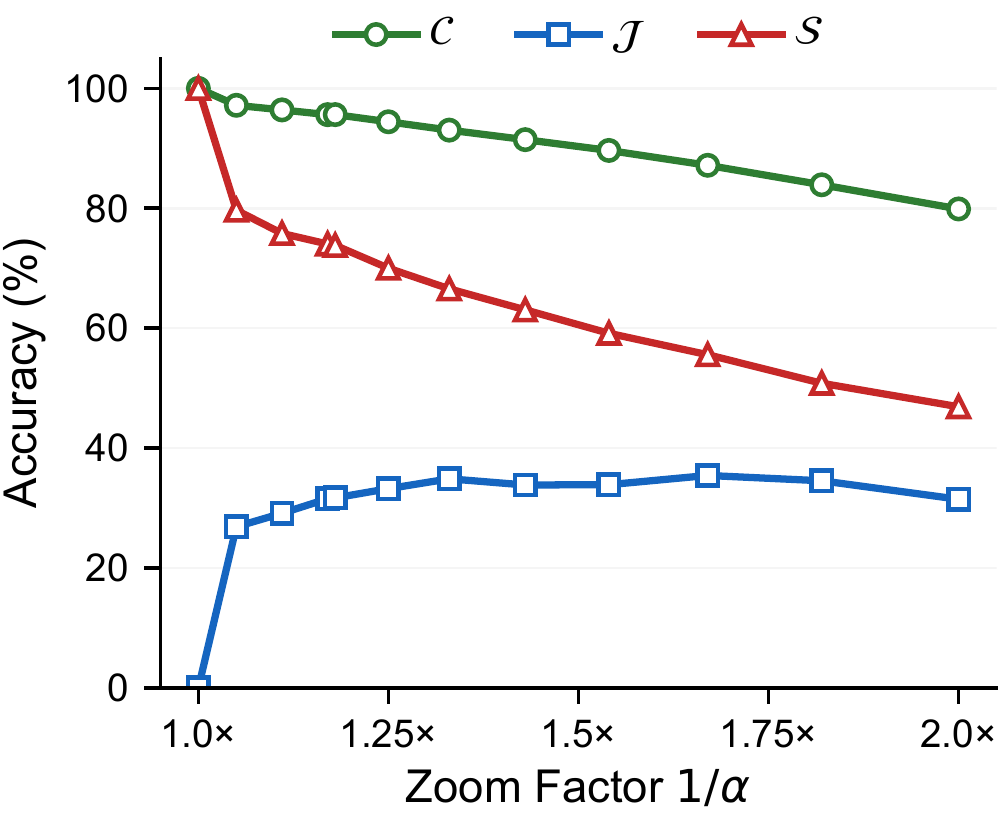
Accuracy versus low-pass radius for the Common, Jammed and Spurious sets. Accuracy versus zoom factor for the Common, Jammed and Spurious sets.
Accuracy of the standard model on each group under low-pass filtering (left) and center zoom (right). 𝒥: Jammed, 𝒮: Spurious, 𝒞: Common.

Less information, better answers. A low-pass filter raises accuracy on jammed images from 0% to 31.8% while Common images stay at 85.1%; spurious images, which rely on high-frequency shortcuts, collapse. Zooming in by a few percent has the same effect.

The cue only works in its own image. Grafting a jammer’s high frequencies onto a Common image passes on its wrong label in only 0.17% of cases, while reassembling the jammer from its own components keeps the wrong prediction 99.9% of the time. The misleading signal is not harmful by itself; it depends on being aligned with its host image.

The Substitution Paradox

Cropping a few pixels off the edges breaks many locks. If jamming were a defect of particular images, the Jammed Set should shrink. It does not.

Edge cropJammed imagesOverlap with the original set (IoU)
none (original)2,1401.00
2%2,2890.46
4%2,2680.42
6%2,2760.38
8%2,2910.35

Individual jammers are fragile; jamming as a whole is not. A 2% crop moves about one third of the jammers out of the Jammed Set, and about as many new images take their place. The particular images change, but the share of jammed images stays about the same.

Code and weights

git clone https://github.com/jiamingzhang94/natural-jammers
cd natural-jammers
pip install -e .
python download_weights.py --lens resnet50_l2_eps1
python build_partition.py --data /path/to/imagenet/val --lens resnet50_l2_eps1
python evaluate.py --data /path/to/imagenet/val --tasks lpf zoom graft substitution

The robust ResNets and WideResNets are the public MadryLab checkpoints; our robust ViTs are on Hugging Face.

BibTeX

@inproceedings{zhang2026natural,
  title     = {Natural Jammers: When Non-Robust Features
               Become Antagonistic},
  author    = {Zhang, Jiaming and Zhang, Fuyao and
               Xie, Pengjun and Lim, Wei Yang Bryan},
  booktitle = {Advances in Neural Information Processing Systems},
  year      = {2026}
}